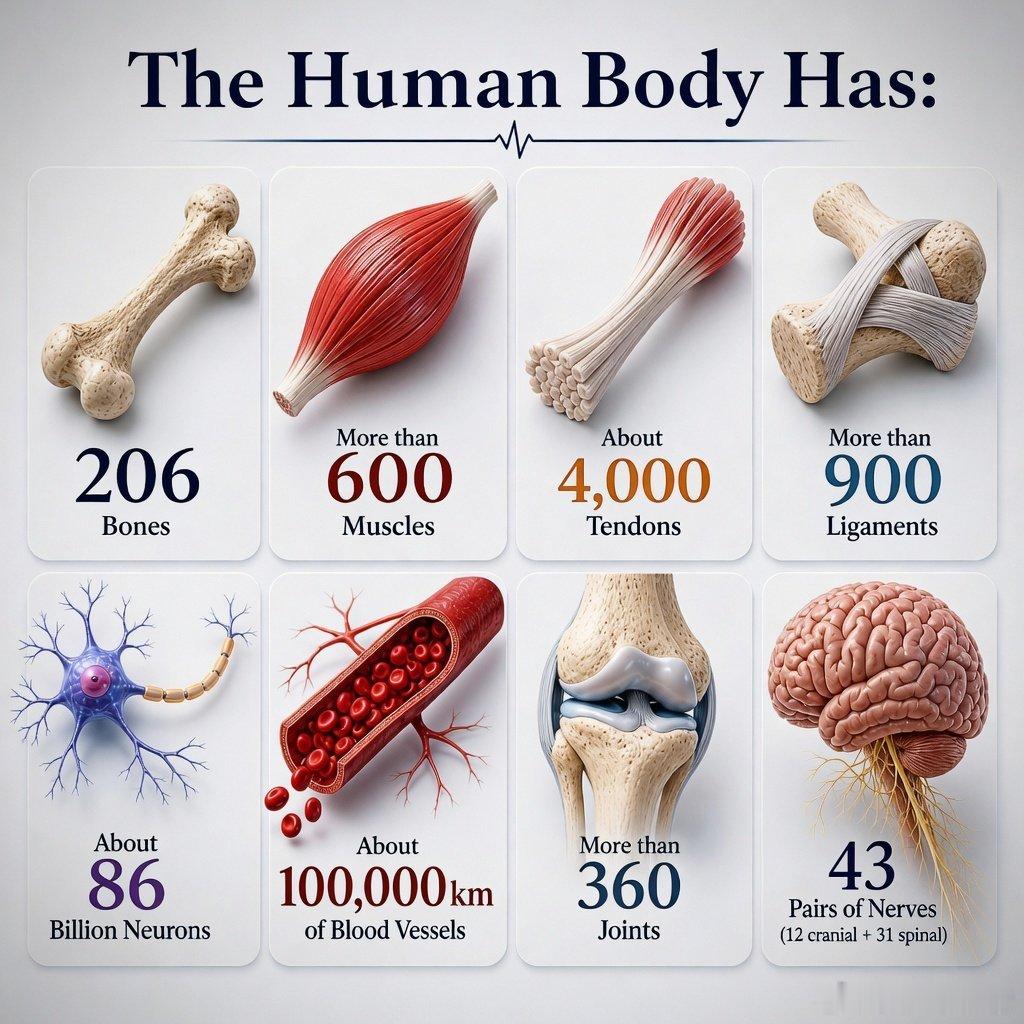
【神奇的人体结构的复杂程度】206块骨骼构成身体结构。600多块肌肉驱动运动。4000条肌腱和900条韧带将所有组织连接在一起。10万公里的血管、860亿个神经元和43对核心神经维持着整个系统的连接和响应。
这是生物工程的杰作。但作为一名企业领导者,我看到这样的信息图,看到的却是组织结构设计的终极蓝图。
一家高效运转的公司就像一个健康的有机体。在构建或扩展业务时,我们必须围绕这些基本要素进行设计:
1. 骨骼与关节(基础设施) 您的组织结构、治理和有形资产就像您的骨骼。它们提供了支撑您直立行走所需的形状和稳定性。但如果没有关节——也就是您的跨职能工作流程和沟通回路——坚硬的骨骼也毫无用处。关节使企业能够在压力下灵活调整而不崩溃。
2. 肌肉与肌腱(执行引擎)肌肉代表你的人才库——执行战略和推动增长所需的庞大劳动力和运营能力。肌腱代表你的核心流程和管理框架。它们是关键的连接点,将原始的肌肉能量转化为有针对性的机械运动。如果你的流程薄弱,你的人才努力就会白费。
3. 神经系统与血管(数据流)你的技术栈、数据管道和内部沟通渠道构成了神经系统。如果信号不能瞬间传递以协调响应,那么860亿个神经元就毫无意义。信息和资金必须像氧气在10万公里长的血管中循环一样持续流动,才能确保每个外围团队与核心愿景保持一致。
最终结论是什么?没有任何一个部门或高管能够独自支撑起整个企业。
真正的组织韧性并非通过过度重视某个要素来实现;它源于整个系统的无缝、同步整合。当每个组成部分都清楚自己的职责并与其他部分完美衔接时,组织将势不可挡。
Look at the sheer complexity of the human body:
206 bones providing structure.
More than 600 muscles driving movement.
4,000 tendons and 900 ligaments anchoring it all together.
100,000 kilometers of blood vessels, 86 billion neurons, and 43 pairs of core nerves keeping the entire system connected and responsive.
It is a masterpiece of biological engineering. But as a business leader, I look at an infographic like this and see the ultimate blueprint for structural organizational design.
A high-performing company operates exactly like a healthy organism. When building or scaling a business, we have to design for the same fundamental components:
1. The Bones & Joints (The Infrastructure) Your organizational structure, governance, and physical assets are your skeleton. They provide the shape and stability required to stand upright. But rigid bones are useless without joints—your cross-functional workflows and communication loops—which allow the business to pivot and flex without breaking under pressure.
2. The Muscles & Tendons (The Execution Engine) Muscles represent your talent pool—the sheer workforce and operational power that executes strategy and drives growth. Tendons are your core processes and management frameworks. They are the critical connectors that translate raw muscular energy into directed, mechanical movement. If your processes are weak, your talent's effort is wasted.
3. The Nervous System & Blood Vessels (The Data Flow) Your technology stack, data pipelines, and internal communication channels form the nervous system. 86 billion neurons mean nothing if the signals don't fire instantaneously to coordinate a response. Information and capital must circulate continuously—like oxygen through 100,000 km of blood vessels—to keep every peripheral team aligned with the core vision.
The ultimate takeaway? No single department or executive can carry an enterprise alone.
True organizational resilience isn't achieved by over-indexing on just one element; it comes from the seamless, synchronized integration of the entire system. When every component knows its role and connects flawlessly to the next, the organization becomes unstoppable.
How are you optimizing the "nervous system" or "connective tissue" of your organization this quarter?